


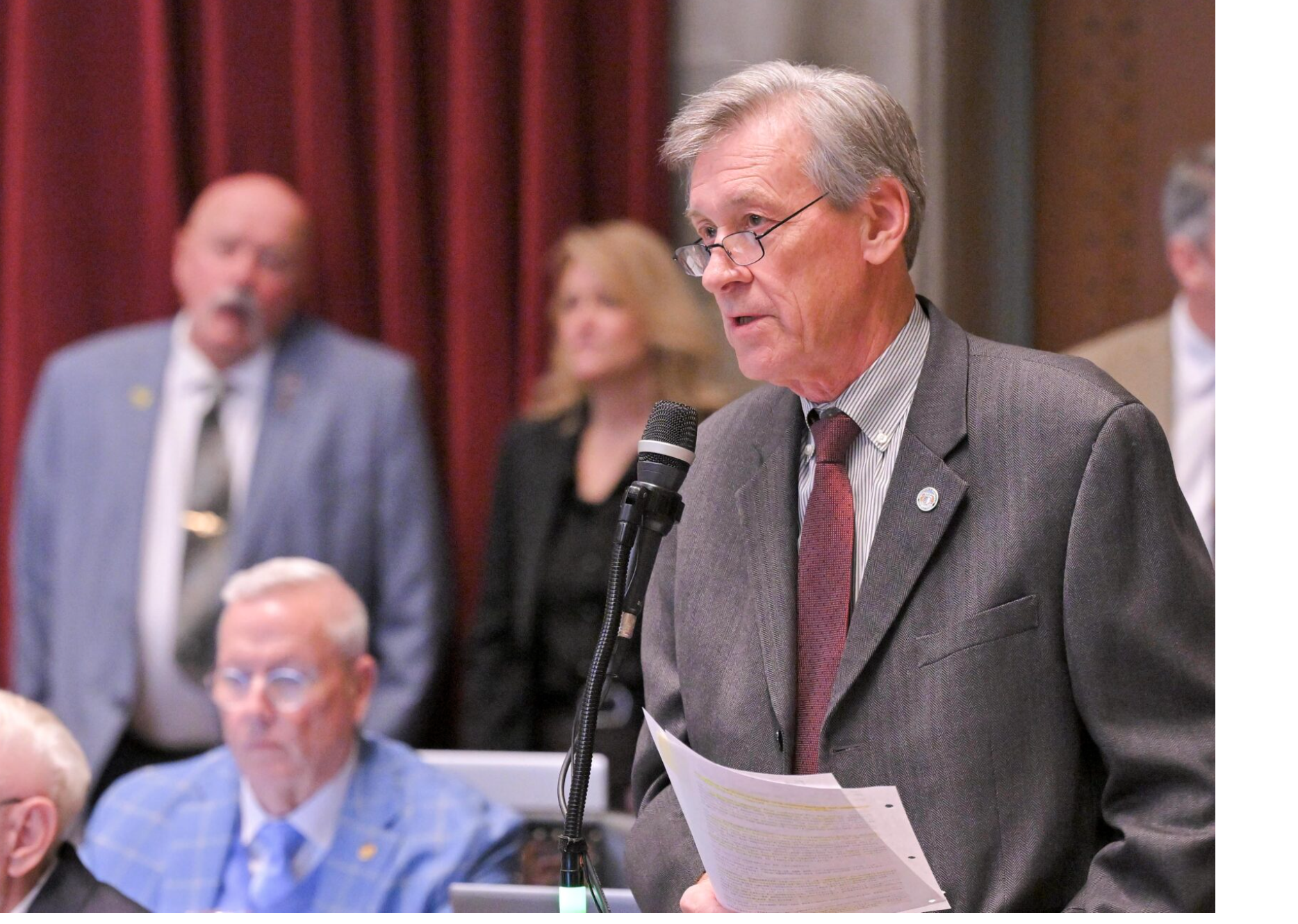
The bill includes a fix designed to address a possible sentencing gap decried by Democrats
BY: Steph Quinn
Missouri Independent
The Missouri General Assembly passed a sweeping public safety bill Wednesday that Democrats say would correct errors in legislation signed by Gov. Mike Kehoe three weeks ago.
The legislation also combines bills aimed at clarifying the state’s sex offender registry law, establishing procedures for court-ordered outpatient treatment of people with severe mental illnesses, allowing lifetime protection orders for some felony victims and banning stalking and harassment on the internet.
It passed 119 to 18 in the House and 25 to 4 in the Senate and now goes to the governor.
Senate Democrats argued last week that criminal justice legislation already signed by Kehoe would have left no sentence in state law for rape or sodomy of a child under 12 until Jan. 1, 2028.
That’s a claim disputed by both the sponsor of the original bill, Republican state Sen. Nick Schroer of Defiance, and the sponsor of the bill Democrats say would fix the mistake, Republican state Rep. John Black of Marshfield.
Black said during debate in the House this week that while he doesn’t think there is a sentencing gap, the Senate had “amended that [in his bill] to alleviate any concerns.”
Schroer said during debate in the Senate that his bill was “fine, but there were some measures that we said in good faith [that] we’ll make some tweaks to language to make it more consistent elsewhere.”
Senate minority caucus staff told The Independent the disagreement was due to a discrepancy between the effective date of increased penalties for rape or sodomy of a child and the effective date of another section of the legislation defining those penalties.
The amended version of the legislation would change all effective dates to Jan. 1, 2028.
Democrats argued that while it’s unlikely that people convicted of those offenses would be able to avoid incarceration due to the discrepancy, it could have caused litigation and confusion about sentencing for people accused of the crimes.
Black’s underlying legislation, which would add into state law mandatory minimum prison sentences before people are eligible for parole, was passed in March as part of Schroer’s legislation, which also allows a greater role for prosecutors in juvenile court proceedings.
Amendments to Black’s bill in the Senate added provisions sponsored by lawmakers spanning both chambers and parties.
“There are a lot of good things in this bill,” Black told The Independent.
Legislation sponsored by Democratic state Rep. Aaron Crossley of Independence, Republican state Rep. Carolyn Caton of Blue Springs and Democratic state Sen. Maggie Nurrenbern of Kansas City would seek to get adults with serious mental illness into up to two years of court-ordered treatment in their communities before they end up hospitalized or incarcerated.
While Missouri law already allows involuntary outpatient treatment as an extension of the state’s civil detention process, supporters of the legislation say the state’s inpatient facilities are so full that patients end up waiting in emergency rooms before they can be committed.
Black, who chairs the state’s Substance Abuse Prevention and Treatment Task Force, said this measure would connect Missourians with substance use and mental health conditions with available treatment.
“Unless people are involved, have a loved one or friend with those kinds of disorders, they don’t realize how troubling it is to try to help the person with the problem if the person with the problem won’t get help,” Black said.
The bill would also make it unlawful to disclose “intimate digital depictions” of someone without their consent, with a maximum penalty of 10 years in prison, or four years for threatening disclosure. This measure is similar to legislation passed by the House earlier this year.
Legislation sponsored by Democratic state Sen. Patty Lewis of Kansas City and added to the bill approved Wednesday would prohibit cyberstalking. It defines the offense as using digital technology or the internet to intimidate, track or follow someone and allows penalties up to $2,000 in fines or one year in jail for the first offense.
Black’s bill also includes a measure sponsored by Republican state Sen. Mike Moon of Ash Grove that would allow courts to enter a lifetime protection order forbidding people convicted of the most serious felonies, such as first degree assault or rape, from contacting their victims.
A measure sponsored by Republican state Sen. Mary Elizabeth Coleman of Arnold would clarify that people convicted of a sex offense in another state who live, study, work or volunteer in Missouri more than seven days per year must register in the state, even if their primary residence is elsewhere. People convicted of a qualifying offense out of state who move to Missouri must also register in Missouri.
The bill hasn’t totally satisfied Democrats who argue that the criminal justice legislation signed by the governor was pushed too quickly through the legislature, allowing too little time for vetting.
Democratic state Rep. David Tyson Smith of Columbia, a member of the conference committee that negotiated the final version of the bill, told The Independent that he still thinks the criminal justice legislation was “rushed through” and “full of problems.”
“We’re kind of helping them fix their mess, and in turn, from us doing that, we’re adding some things that we like,” Smith said. “I don’t like this process. I don’t like how it’s done.”