


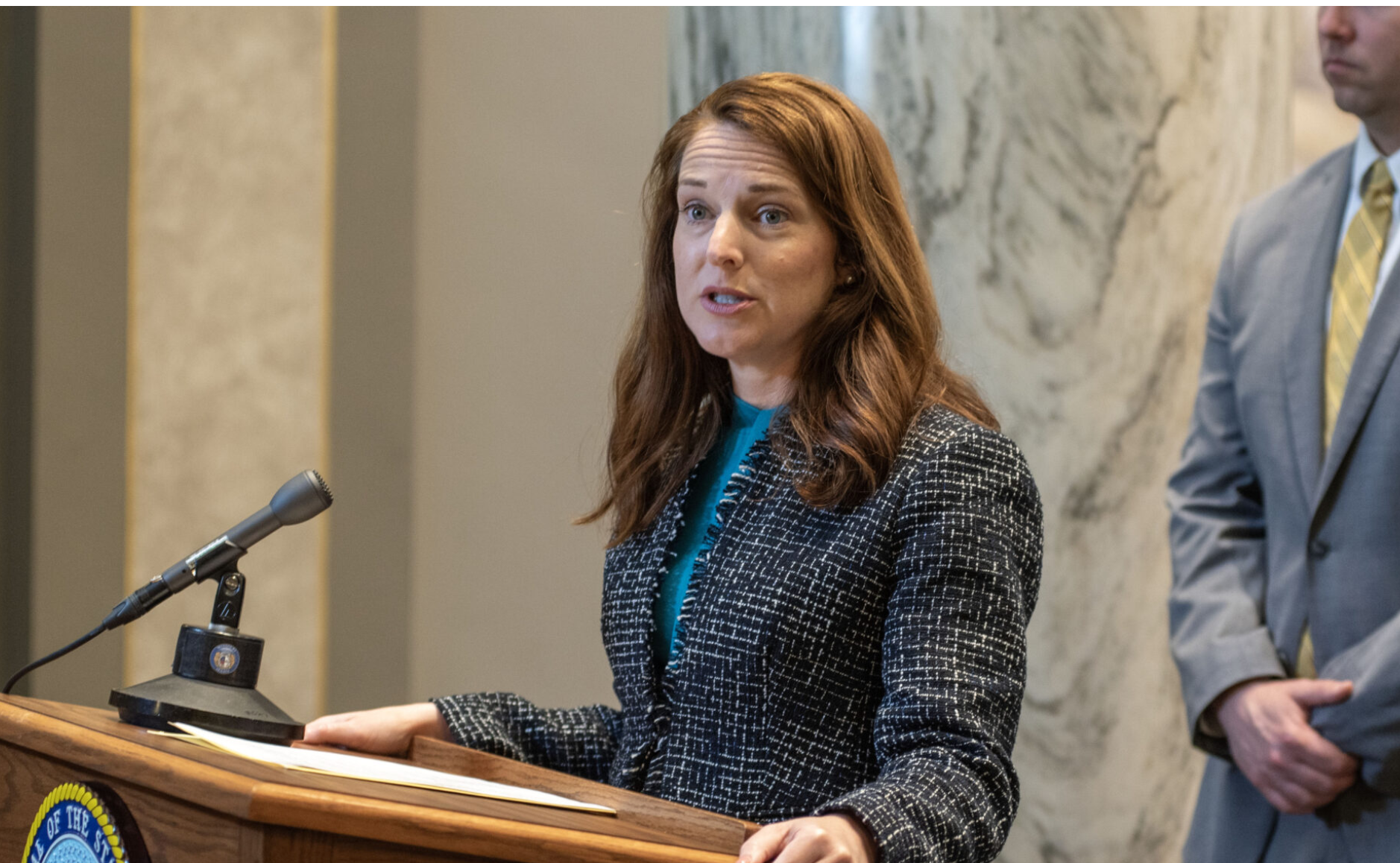
The bill would outline a framework for involuntary community-based mental health treatment. Supporters of the legislation, which passed the Senate unanimously, say it would reduce hospitalizations and incarcerations
BY: Steph Quinn
Missouri Independent
Missouri lawmakers advanced legislation this week to create a clear pathway for adults with severe mental illness to receive court-ordered treatment in their communities before they end up hospitalized or incarcerated.
It would establish procedures for doctors, legal guardians and public health directors to petition courts to order up to two years of outpatient treatment for people unwilling to seek care voluntarily.
The Senate gave unanimous approval to the bill, sponsored by Democratic state Sen. Maggie Nurrenbern of Kansas City. A House committee discussed a nearly identical version earlier this month, sponsored by Republican state Rep. Carolyn Caton of Blue Springs and Democratic state Rep. Aaron Crossley of Independence.
During the House hearing, witnesses shared successes from a Jackson County pilot program and underscored the human cost of a system that often relies on inpatient hospitalization only after someone has reached a breaking point.
Dr. Thomas Chaffee, a psychiatrist at University Health in Kansas City, said he maintains a list of patients that he checks “just to wait and see if they’ve died yet.”
Chaffee said one of his patients stops eating when he goes off his medication. Under current Missouri law, he has to wait until the patient is at “imminent serious risk” in order to hospitalize him for immediate inpatient evaluation and care.
“I just have to wait until he’s sufficiently starved to some point where I can intervene,” Chaffee said. “If he’s lost 30 pounds, is that enough? What about 50 pounds?”
When patients who “are so sick” don’t seek care, Chaffee said, the consequences can be “serious and heinous… death of children, loss of limbs, loss of eyes.”
Missouri law already permits court-ordered outpatient treatment as an extension of the state’s civil detention process. Any adult can ask a court to order someone with a severe mental health condition into a hospital or mental health facility for up to 96 hours of inpatient evaluation and treatment.
But supporters of the proposed legislation said Missouri’s inpatient mental health facilities are full, leaving people who have been ordered into 96-hour holds stuck waiting in emergency rooms.
There are also growing backlogs for inpatient psychiatric facilities run by the Missouri Department of Mental Health.
In December, the average number of Missourians awaiting treatment from the department topped 500 — with most of them in jail. In February, the daily average was 528, according to the department. None of those people have been convicted of the crimes that landed them in jail. They were ruled incompetent to stand trial due to a mental health condition or cognitive disability and ordered into treatment from the department.
Jackson County Public Administrator John Killian said during the House hearing that inpatient beds — in public or private hospitals — are so scarce that he often looks for placements out of state or in nursing homes for clients in need of treatment.
“You may have to look for a bed across the state,” he said. “I will say that is absolutely a common experience. I can’t count the number of clients that I have sitting in emergency rooms or departments waiting for a psychiatric bed somewhere.”
Crossley, a former behavioral health case manager, emphasized the importance of providing structured treatment in a patient’s community.
“An old model was, we take you out of the community, and now you’re ours forever,” Crossley said. “What I would like to see as a social worker, as a behavioral health provider, is people reconnected with their family members, to those strengths that exist in their family that make all of us strong.”
Cost and effectiveness
Republican state Rep. David Dolan of Sikeston, a juvenile court judge in the 33rd Circuit, asked about the track record and potential costs of assisted outpatient treatment.
“How you approach the legislature is with evidence-based practices and statistics about costs and cost opportunity,” he said.
Judge Mark Styles Jr., a probate court judge in the 16th Circuit, said the pilot program hasn’t added any costs.
“The resources are already there,” he said. “What we’re doing is pulling the resources together in a program to save costs.”
Since the pilot launched about a year ago, Styles said, four people have participated. Two have graduated, and none have had to be re-hospitalized.
Styles also cited other state’s successes with assisted outpatient treatment.
In Kentucky, Medicaid expenditures decreased by an average of $1,326.22 per participant per month during assisted outpatient treatment and $1,105.45 after treatment ended across 67 participants over six years, according to a 2025 study. Hospitalizations during treatment decreased 53% and 67% after treatment.
In Houston, assisted outpatient treatment was associated with a 33% decrease in time spent in prison across 175 participants, according to a 2025 study.
The legislation would require participants to go to court at least every 90 days with their case manager, a mental health professional who would monitor their progress. “Substantial failure” to comply could lead to the person’s evaluation at a mental health center or short-term hospitalization.
But Styles told The Independent it’s not intended to be a punitive process. During his meetings with participants, he sits down with them and asks them how they’re doing and if they need help with housing or employment. And he doesn’t wear his robes.
“My job is not to say, ‘Hey, this is what you’ve done wrong and what you’ve done right,’” he said. “No, it’s to help you get through this. ‘Tell us what you need. How are things going?’”
A multi-generational process
Nurrenbern told The Independent that while she hopes the bill will help address mental health backlogs by getting people help earlier, the state will “need to do a lot more.”
“Underneath all of this, we truly are hemorrhaging when it comes to folks crying out for help for behavioral health,” Nurrenbern said. “So this is another approach to help, but we have to take more drastic steps.”
Killian said it could take decades to address deficits in Missouri’s mental health system.
“It is a longer term, I’ll even guess, multi generational process where they’re looking at catching people earlier to prevent those later, more extreme challenges down the road,” he said.
Assisted outpatient treatment, Styles said, is “actually treating the issue.”
“We’re giving them the help they need in the community to help them stay out of jail, stay out of hospitals, to allow the really sick people to get the psych beds that they need,” Styles said, “rather than them having to get sicker and then commit a crime.”