


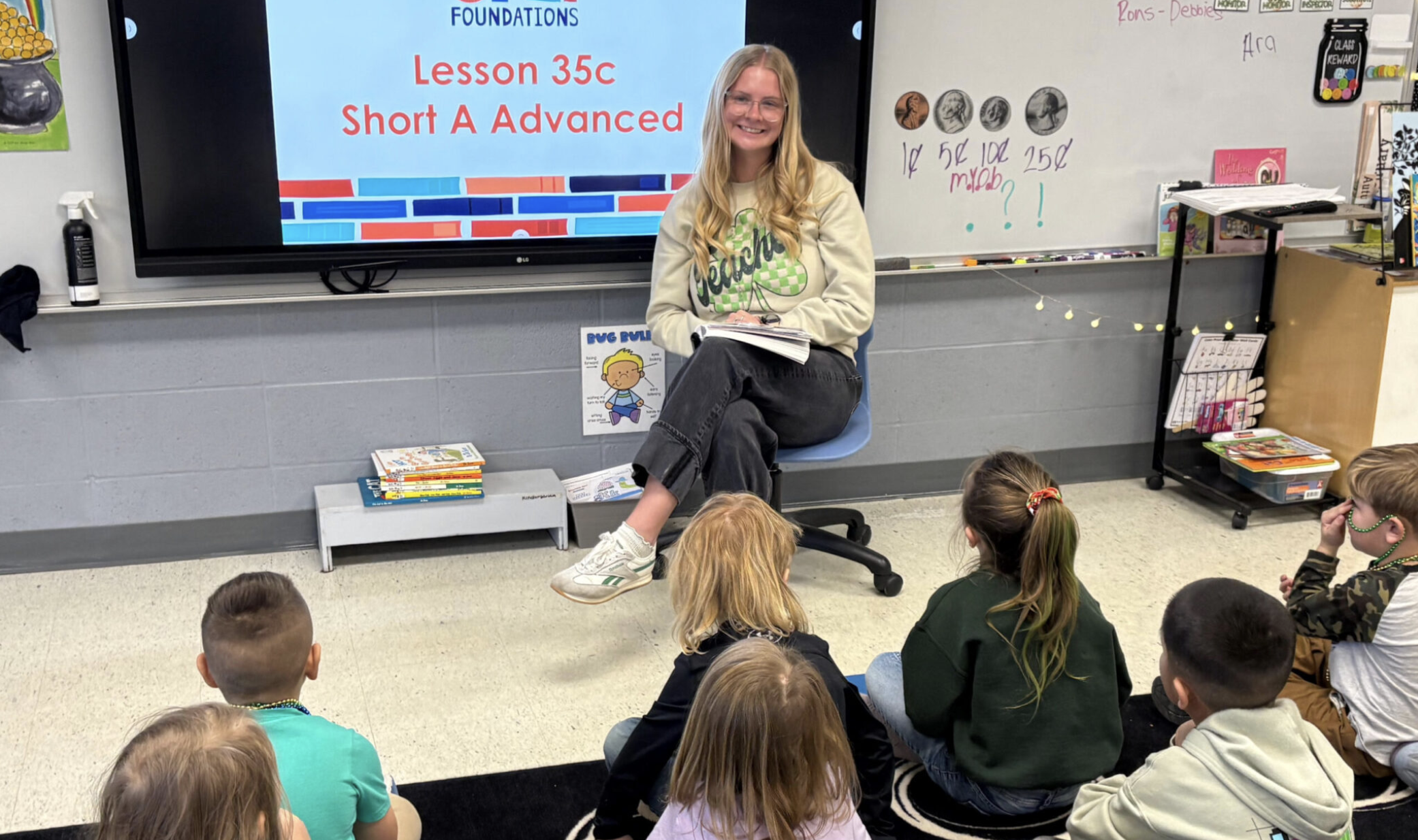
The Rural Schools Early Literacy Collaborative is helping teachers build stronger reading foundations for young students
By:William Hehemann
Missouri Independent
In early 2026, a small group of first-grade students at Lucy Wortham James Elementary School in St. James, Missouri, sat together sounding out words.
Kim Williams, the school’s principal, watched as they worked through the lesson. One young boy caught her attention.
“This student had struggled significantly the year before and often avoided reading tasks,” she said. “This time, I watched him carefully tap out each phoneme, blend the sounds and read a multi-syllable word independently.”
What stood out wasn’t just that he read the word correctly – it was how he approached it.
“He didn’t guess. He didn’t look to the teacher for the answer. He applied a strategy he had been explicitly taught,” Williams said.
She has observed several meaningful changes in students over the past year.
“Students are approaching unfamiliar words with greater confidence,” she said. “Instead of guessing, they are using strategies and applying phonics patterns they’ve been explicitly taught. You can hear the difference – they are sounding out words more accurately and blending more smoothly.”
The breakthrough she observed is part of a broader effort across rural central Missouri. Through the Rural Schools Early Literacy Collaborative, literacy coaches from the national nonprofit TNTP work directly with teachers in Phelps County schools, helping them implement structured reading instruction grounded in the science of reading.
Coordinated locally through the Phelps County Community Foundation, coaches visit classrooms regularly throughout the school year. They observe instruction, model lessons and provide feedback, strengthening foundational reading instruction for kindergarten and early elementary students.
The effort is taking place at a time when reading proficiency remains a challenge across Missouri and the nation. According to the 2024 National Assessment of Educational Progress, often called the Nation’s Report Card, only 27 percent of Missouri fourth-grade students scored at or above the proficient reading level, while 42 percent scored below the basic level.
Education leaders say improving early literacy is critical because reading proficiency by the end of third grade is closely linked to long-term academic success.
Before the collaborative began, the biggest challenges for K–1 teachers in St. James R-I centered on consistency, skill gaps and limited structured support.
“Teachers were using a variety of reading strategies, programs and materials,” Williams said. “While many approaches had strengths, there was not a cohesive, research-aligned framework guiding K–1 reading instruction across classrooms. This sometimes led to uneven student outcomes and confusion when students moved between grades.”
Some students entered kindergarten with limited literacy exposure, and teachers needed clearer tools to systematically build phonemic awareness, phonics and decoding skills. Identifying and addressing skill gaps early was challenging without a unified approach.
“From my perspective as principal, the most significant change since TNTP coaches began working with our teachers has been the shift to consistently structured, research-based literacy instruction grounded in the science of reading,” she said.
Instead of learning strategies in isolation, teachers now receive feedback tied directly to classroom instruction. Coaching conversations are specific, practical and immediately applicable, accelerating growth in instructional practice.
“I have seen a significant shift in teacher confidence, collaboration and mindset around early literacy instruction,” Williams said. “Teachers understand how students learn to read, have a stronger grasp of foundational skills — especially phonemic awareness, phonics and decoding – and can clearly articulate the ‘why’ behind their decisions.”
That clarity has reduced uncertainty and increased instructional precision.
“Early literacy is no longer just an initiative,” she said. “It’s a unified commitment supported by knowledge, collaboration and confidence.”
A first-year teacher finds support
For Ashley Wood, a second-year kindergarten teacher in Newburg, the coaching model provided unexpected support.
“You see so many posts online telling new teachers to run from the profession,” she said. “But when you have a support system – coaching, small groups, someone to talk through what’s working and what’s not – it makes you want to stay. It takes away that feeling that if a student struggles, it’s all your fault.”
Wood said the approach reduces “teacher guilt” – the feeling that struggling students are solely the teacher’s responsibility.
Her literacy coach, Kelly, follows a predictable rhythm each month: a Zoom planning meeting before a visit, in-person classroom observation, immediate feedback afterward and ongoing email check-ins.
“It definitely makes you feel like you are not alone,” Wood said. “As a new teacher, there are so many moments where you wonder if you’re doing it right. Having someone come in, observe and then talk it through with you – it changes everything.”
At the beginning of the year, some students did not yet recognize their starter letters – A, M, S and T – or the sounds they make.
“Now almost every single one of them knows capital, lowercase and sound,” she said. “That growth has been huge. Kindergarten is such a growth year. They come in barely recognizing letters, and by the end they’re reading.”
Wood admitted feeling nervous before Christmas break, wondering whether students would retain their skills.
“I sent home decodable passages because I thought, ‘They’re going to forget everything.’ But they came back after break and every single one of them just took off. It was like something clicked,” she said.
The improvements teachers are seeing in classrooms are reflected in early assessment data from participating districts.
In Rolla Public Schools, more than 94 percent of first-grade students demonstrated year-long growth in reading after coaching support began. In Dent-Phelps R-III School District, the share of first graders reading at grade level increased from 25.5 percent in the fall to 89.4 percent by the spring.
At Newburg Elementary School, 100 percent of kindergarten and first-grade students demonstrated growth in reading assessments, with gains that more than doubled typical annual progress.
From classroom change to district strategy
For April Williams, assistant superintendent in the St. James R-I School District, the impact is most visible during classroom visits.
“As an administrative team, we met every Wednesday morning and did literacy walks,” she said. “We wanted to be grounded in the work, too – not just supporting teachers but really understanding what effective literacy instruction should look like.”
Those visits give district leaders a firsthand view of how instruction – and students – are changing.
“Just last week I was in a kindergarten classroom, and the words students were decoding and understanding – for February – I couldn’t believe it,” she said. “Seeing that difference in students’ abilities has been incredible.”
What began as a local effort in rural Phelps County is now expanding across Missouri.
Through the state’s Comprehensive Literacy State Development (CLSD) grant, the coaching model is being implemented in 60 schools statewide, including 40 K–5 schools and 20 middle and high schools. Literacy coaches trained in the same model used in Phelps County now support teachers across multiple regions of the state.
Education leaders say the expansion reflects growing recognition that improving reading outcomes requires not only strong curriculum but also sustained coaching and support for teachers.
For Williams, the goal is simple: ensure the work continues long after the original grant funding ends.
“Probably what changed the most is we renewed our commitment to literacy district-wide,” she said. “It wasn’t just something happening in elementary anymore – we started asking how the entire district supports literacy and keeps it at the forefront of everything we do.”
She added: “The goal is for this model to live beyond the grant — and beyond all of us. So that it simply becomes what we do.”